When Star Wars was young, the need for Star Wars was as strong as it is today.
Fans cried out for more and a man named Russ Manning helped do that.
Known for his work on the Tarzan and son of Tarzan comics from Dell and newspaper strips, Russ Manning was a master. His Magnus Robot Fighter placed him well into the genre of sci-fi as well.
Showing posts with label DELL FOUR COLOR COMICS. Show all posts
4/10/2017
5/10/2016
Toth Tuesdays!
Alex Toth possessed a skill to match his temperment - always striving to improve - never, it seems, content.
Yet in all his work, an attention to storytelling economy and detail only where necessary.
Details we seldom got to see because his pencils are so rarely available.
His inkers - seldom his partners, inked per their own style - with no fault suggested. His own work in ink fitted his desired finish, often it seems, in a mind to complete the work through experimentation.
TOTH...!
Yet in all his work, an attention to storytelling economy and detail only where necessary.
Details we seldom got to see because his pencils are so rarely available.
His inkers - seldom his partners, inked per their own style - with no fault suggested. His own work in ink fitted his desired finish, often it seems, in a mind to complete the work through experimentation.
![]() |
| His style in this Rip Hunter...! |
Labels:
A First Salvo,
Action,
Adventure,
Alex Toth,
Animation,
books,
Comics,
DC COMICS,
DELL FOUR COLOR COMICS,
Fantasy,
GOLD KEY,
graphic novels,
Sci-fi,
TOTH,
Toth Tuesdays
4/29/2014
Toth
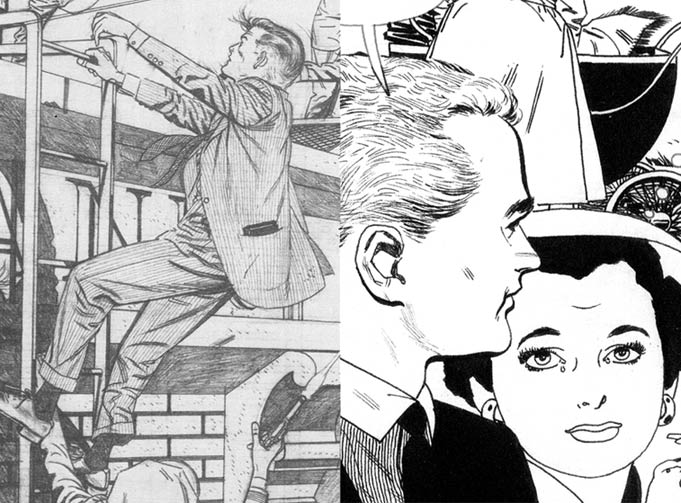
His economy of line, placement of blacks, his sense of design. These are things easily discernible with the eye. Toth's art is bold and for some, "too simple". That's the deceptively obvious misconception of his work. It is not simple. Only through much thought given to composition and layout (and experience), did Toth arrive at pages of such clarity. He COULD have added more line-work - hatching, stippling (which he often did) and the like - but why, when he could define more with one line than three or four.
Many a master illustrator - Toth's peers in time period and creative mastery - advocated the same approach. Every line must have a meaning. Even if simply decorative, they were placed with PURPOSE. As an accent to another line or shape, or to define the same. Question: when does a line become a shape? Toth knew. The shapes created by his placements of black unified a picture's compositional balance, while strengthening its impact.
Often, there was no delicacy of line - he'd ink with a marker and wasn't really bothered with technique in that regard. For each job, consideration of line and rendering of what textures he choose to include, always came back to his rule - Keep It Simple.
This simplicity led Toth to the animation industry, crafting countless model sheets and storyboards - most well known being Space Ghost and the various Super Friends cartoons.
It was his exposure to these working methods that further evolved his art. His brief forays back to comics in the 1970s and 80s were very different from earlier work. This is to be expected, as the majority of artists always strive to improve their art and by nature of experience and time, the art changes.
A funny note, something to look for among some artists: with age and girth of illustrators, figures tend to increase in size. Stockier, thicker figure drawings become common. While this is true of many artists, it doesn't appear in the work of Gil Kane - the figures of his final two decades remained the same proportion (and so did he). Yet look at Kane's style evolution from the 1960s through 1970s (that's surely a post to come).
Toth's most hidden work to many today, are his many stories told at Dell. Dell Four Color and a title or two like Disney's Zorro. Besides some fabulous work for DC on House of Mystery and romance comics, his far more detailed work was found in warren's Creepy/Eerie - some of his final 'full' comic work.
And come to think of it, you don't really read much about Toth's women---
Toth could draw some hot ladies!
Many a master illustrator - Toth's peers in time period and creative mastery - advocated the same approach. Every line must have a meaning. Even if simply decorative, they were placed with PURPOSE. As an accent to another line or shape, or to define the same. Question: when does a line become a shape? Toth knew. The shapes created by his placements of black unified a picture's compositional balance, while strengthening its impact.
This simplicity led Toth to the animation industry, crafting countless model sheets and storyboards - most well known being Space Ghost and the various Super Friends cartoons.
It was his exposure to these working methods that further evolved his art. His brief forays back to comics in the 1970s and 80s were very different from earlier work. This is to be expected, as the majority of artists always strive to improve their art and by nature of experience and time, the art changes.
A funny note, something to look for among some artists: with age and girth of illustrators, figures tend to increase in size. Stockier, thicker figure drawings become common. While this is true of many artists, it doesn't appear in the work of Gil Kane - the figures of his final two decades remained the same proportion (and so did he). Yet look at Kane's style evolution from the 1960s through 1970s (that's surely a post to come).
Toth's most hidden work to many today, are his many stories told at Dell. Dell Four Color and a title or two like Disney's Zorro. Besides some fabulous work for DC on House of Mystery and romance comics, his far more detailed work was found in warren's Creepy/Eerie - some of his final 'full' comic work.
And come to think of it, you don't really read much about Toth's women---
Toth could draw some hot ladies!
Labels:
A First Salvo,
BLACK CANARY,
Comic,
Comics,
Conan,
DC,
DC COMICS,
DELL FOUR COLOR COMICS,
Gil Kane,
GOLD KEY,
graphic novels,
Green Lantern,
Illustration,
Kane,
Sketches,
TOTH,
Toth Tuesdays
2/03/2014
1/13/2014
1/06/2014
Manning Mondays
Russ Manning had a mastery of the simple line that was, like Toth, more about what he DIDN'T draw as what he did...
Leaves, foliage - defined by outline and silhouette. The ground by shadows. He also understood the power of spotting powerful blacks, using shadow to define shapes and dynamics, rather than hide a lack of knowledge of form.
From Korak, to Tarzan, to his own Magnus Robot Fighter, Manning penned wild adventures in exotic, far away places, those lost in time and those years in the future... or a long time ago.
Leaves, foliage - defined by outline and silhouette. The ground by shadows. He also understood the power of spotting powerful blacks, using shadow to define shapes and dynamics, rather than hide a lack of knowledge of form.
From Korak, to Tarzan, to his own Magnus Robot Fighter, Manning penned wild adventures in exotic, far away places, those lost in time and those years in the future... or a long time ago.
Labels:
A First Salvo,
Action,
Adventure,
Art,
Comic,
Comics,
DELL FOUR COLOR COMICS,
Illustration,
Manning Mondays,
RUSS MANNING,
Star Wars
2/28/2010
Manning Marvel...
Russ Manning is not a name you hear very much of today, but he is associated with quite a famous character - Tarzan.
From 1965 to 1972 Manning was the daily and Sunday newspaper strip artist for Tarzan. Leaving the daily strip in 1972, he continued to work on the Tarzan Sunday Pages and Tarzan stories for the European market. In both can be found some of his greatest work. He also worked for Dell, producing Tarzan comics and it was there, through Western - Gold Key, that his own creation was born.
Magnus Robot Fighter! Magnus was a hero in the mold of Doc Savage - intelligent, tough, and direct, even "savage" in his own right. Many have very accurately described Magnus as Manning's technological Tarzan - their character was very much alike.
Manning also produced work on a wide variety of stories at Dell, which is some of his earliest work.
However, his excellent draftsmanship was all in place. The later work merely shows a greater confidence in figure poses - learned no doubt by his work on the Tarzan dailies. Practice makes perfect.
Magnus came to greater fame, to an all new generation thanks to Valiant Comics. Later, Manning's work was reprinted as was his rare Johner and the Aliens. Today, Dark Horse releases impressive hard covers of Magnus, with Manning's great art on display.
Considering the period in which he worked, it is not difficult to think of Manning at DC or Marvel. While his art better suited the DC house style, what about Marvel? Easily able to delineate any of DC's sci-fi books of the time, or contribute to Showcase or Brave and the Bold, on titles like The Metal Men, what about Manning at Marvel? On what character?
Marvel in the 1960s, was just being created - or at least all of the characters we associate with Marvel, and a few key artists were responsible. Considering the content of Magnus Robot Fighter, the obvious hero for Russ Manning, would have been Iron Man. Artists Don Heck and Jack Kirby established Shell Head in Tales of Suspense. Heck drew through issue 72 of 1965, with Steve Ditko penning the intro of the red and gold armor. Gene Colan followed Heck, penciling a memorable run, one that many consider as defining the character for the so-called Bronze Age. What if Colan had remained on Daredevil? Or Daredevil and Captain America, and Manning had illustrated Iron Man? What if?
Of course, we could consider the limitless possibilities of Manning at DC. Myster in Space, Strange Adventures? Maybe the Legion (although he never drew anything approaching a team book), and of course, the Metal Men, because of his work on Magnus. He 'did' come to DC, when DC took over the Tarzan license and reprinted Manning's work, but he never penned any of the DC characters he could have drawn so well.
Whatever the case, the goal of many a cartoonist was to draw for the newspapers, and Manning did this with great skill on Tarzan. He worked on his own creation in comics and perhaps his work was stronger for having done both.
Sadly, Manning died in 1981, and he did not come to prominence as perhaps he would, as comic fandom continued to mature. Today, we see an often heavy-handed and very detailed comic page. Yet Manning, through all his work detailed more with less and with clean, crisp line-work, told stories with great economy of art. His jungles abounded and still, when studying the images, much was done through silhouette - often outline with fill-color and shadow. A few well-placed and simply rendered leaves and or branches and vines held it all together. All in service of the characters and plot. Usually framing the key characters and providing a beautiful 'stage' upon which grand stories were told.
From 1965 to 1972 Manning was the daily and Sunday newspaper strip artist for Tarzan. Leaving the daily strip in 1972, he continued to work on the Tarzan Sunday Pages and Tarzan stories for the European market. In both can be found some of his greatest work. He also worked for Dell, producing Tarzan comics and it was there, through Western - Gold Key, that his own creation was born.Magnus Robot Fighter! Magnus was a hero in the mold of Doc Savage - intelligent, tough, and direct, even "savage" in his own right. Many have very accurately described Magnus as Manning's technological Tarzan - their character was very much alike.
Manning also produced work on a wide variety of stories at Dell, which is some of his earliest work.
However, his excellent draftsmanship was all in place. The later work merely shows a greater confidence in figure poses - learned no doubt by his work on the Tarzan dailies. Practice makes perfect.
Magnus came to greater fame, to an all new generation thanks to Valiant Comics. Later, Manning's work was reprinted as was his rare Johner and the Aliens. Today, Dark Horse releases impressive hard covers of Magnus, with Manning's great art on display.
Considering the period in which he worked, it is not difficult to think of Manning at DC or Marvel. While his art better suited the DC house style, what about Marvel? Easily able to delineate any of DC's sci-fi books of the time, or contribute to Showcase or Brave and the Bold, on titles like The Metal Men, what about Manning at Marvel? On what character?
Marvel in the 1960s, was just being created - or at least all of the characters we associate with Marvel, and a few key artists were responsible. Considering the content of Magnus Robot Fighter, the obvious hero for Russ Manning, would have been Iron Man. Artists Don Heck and Jack Kirby established Shell Head in Tales of Suspense. Heck drew through issue 72 of 1965, with Steve Ditko penning the intro of the red and gold armor. Gene Colan followed Heck, penciling a memorable run, one that many consider as defining the character for the so-called Bronze Age. What if Colan had remained on Daredevil? Or Daredevil and Captain America, and Manning had illustrated Iron Man? What if?
Of course, we could consider the limitless possibilities of Manning at DC. Myster in Space, Strange Adventures? Maybe the Legion (although he never drew anything approaching a team book), and of course, the Metal Men, because of his work on Magnus. He 'did' come to DC, when DC took over the Tarzan license and reprinted Manning's work, but he never penned any of the DC characters he could have drawn so well.
Whatever the case, the goal of many a cartoonist was to draw for the newspapers, and Manning did this with great skill on Tarzan. He worked on his own creation in comics and perhaps his work was stronger for having done both.
Sadly, Manning died in 1981, and he did not come to prominence as perhaps he would, as comic fandom continued to mature. Today, we see an often heavy-handed and very detailed comic page. Yet Manning, through all his work detailed more with less and with clean, crisp line-work, told stories with great economy of art. His jungles abounded and still, when studying the images, much was done through silhouette - often outline with fill-color and shadow. A few well-placed and simply rendered leaves and or branches and vines held it all together. All in service of the characters and plot. Usually framing the key characters and providing a beautiful 'stage' upon which grand stories were told.
Labels:
Comics,
DC,
DELL FOUR COLOR COMICS,
GOLD KEY,
IRON MAN,
MARVEL,
RUSS MANNING
2/07/2010
Alex Toth
So little is said about Toth today, and yet so much in terms of the amount of his art, has become available. Though rare in that they are limited in number and produced by smaller publishers, the variety of books with his art is a pleasant surprise to this admirer of his work. DC Comics is really "missing the boat" in regards to their full library of Toth material - from his first through to the 1950s and then spatters through the 60s and 80s. Great stuff - particularly his Black Canary tale.
His influence is widespread among artists, within the industry - both comics and animation - but not among the reading public. His simplicity of line is something artists appreciate, but many a 'layman' don't agree that "less is more". Any heavily delineated, even "over-worked" piece of art is given more value, attributed more required skill to render. That is by no means true, yet there are clear examples where the details are truly penned by masters of great skill...
Bernie Wrightson, Mark Shultz, and Al Williamson readily come to mind. These three gents use great detail with incredible skill, yet, like Toth, understand what it takes to "build" an image from scratch. Each works differently and yet each of them see the mastery in Toth's economy of line. They add great detail, as this piece by Wrightson clearly shows.
These details are by definition, "rendering". Toth's art has very little rendering or modeling of form. The art of Schultz and Williamson evoke fantasy and sci-fi and particularly in Wrightson's work - horror. And that is true also of Toth - more horror than fantasy or adventurous sci-fi like Williamson or Shultz, yet he's been there too - he's done it all. Toth's best know yet rarely seen - DELL Four Color #845, The Land Unknown is a great 1950s adventure romp in the Antarctic.
And here we see his great use of design and economy. The angular, simple, yet defining imagery of the sea ice and its environment - the vast sense of space. Of the men and equipment, and later the jungle and all therein.
Toth's work abounds in several Dell comics - from his work on Disney's Zorro, to a number of other titles, usually adaptations of television and movies.
We'll comment often about Toth here - as an influence upon A First Salvo. But how does his style relate to Contract? Quite simply, Crime comics - noir - black and white, or more to the point, heavy shadows. While Contract is known for its humor and sci-fi elements, it also has its crime comic ties, and that too will be presented as further story shorts and volumes of Contract are presented on the web, through our digital distribution partners and of course in print.
Toth drew hot ladies and knew how to successfully place blacks. How cool to have seen a pugnacious Panzer by Toth? A hot vixen with a gun - Jessie of course! Or the layabout Tsumi, with an Errol Flynn glint in his eye?
His influence is widespread among artists, within the industry - both comics and animation - but not among the reading public. His simplicity of line is something artists appreciate, but many a 'layman' don't agree that "less is more". Any heavily delineated, even "over-worked" piece of art is given more value, attributed more required skill to render. That is by no means true, yet there are clear examples where the details are truly penned by masters of great skill...
Bernie Wrightson, Mark Shultz, and Al Williamson readily come to mind. These three gents use great detail with incredible skill, yet, like Toth, understand what it takes to "build" an image from scratch. Each works differently and yet each of them see the mastery in Toth's economy of line. They add great detail, as this piece by Wrightson clearly shows.
These details are by definition, "rendering". Toth's art has very little rendering or modeling of form. The art of Schultz and Williamson evoke fantasy and sci-fi and particularly in Wrightson's work - horror. And that is true also of Toth - more horror than fantasy or adventurous sci-fi like Williamson or Shultz, yet he's been there too - he's done it all. Toth's best know yet rarely seen - DELL Four Color #845, The Land Unknown is a great 1950s adventure romp in the Antarctic.
And here we see his great use of design and economy. The angular, simple, yet defining imagery of the sea ice and its environment - the vast sense of space. Of the men and equipment, and later the jungle and all therein.
Toth's work abounds in several Dell comics - from his work on Disney's Zorro, to a number of other titles, usually adaptations of television and movies.
We'll comment often about Toth here - as an influence upon A First Salvo. But how does his style relate to Contract? Quite simply, Crime comics - noir - black and white, or more to the point, heavy shadows. While Contract is known for its humor and sci-fi elements, it also has its crime comic ties, and that too will be presented as further story shorts and volumes of Contract are presented on the web, through our digital distribution partners and of course in print.
Toth drew hot ladies and knew how to successfully place blacks. How cool to have seen a pugnacious Panzer by Toth? A hot vixen with a gun - Jessie of course! Or the layabout Tsumi, with an Errol Flynn glint in his eye?
Subscribe to:
Posts (Atom)